Minor Wound Care
Managing Eye Injury Emergencies
The eye can be injured very easily; proper first aid given right away may prevent partial or complete loss of eyesight. Tears may not be enough to loosen and wash away irritating particles on the eye.
Some signs and symptoms that will indicate an injury to the eye include:
- Pain (mild to severe) usually starting a few hours after the incident
- Redness to the eyes
- Blurred or double vision
- Photosensitivity
- Watery eyes
- Excessive tearing
- Feelings of grit or a particle under the lid
- Broken blood vessels or red spots
- Bleeding
- Clear, thick fluid coming from the eye
- Deformities to the eyes (lacerations, abrasions, or broken bones around the eye)
- Loss of vision
Examining the Eye to Assess Injury
To examine the eye to determine the extent and nature of injury, consider and perform the following as required:
- Assess the injured eye(s) for equal gaze (eyes appear the same and move in the same direction) equal pupil shape and response, presence of a foreign body, fluid/blood draining from the eye, swollen or lacerated eyelids, bright red conjunctiva, etc.
- If the injury is the result of an Arc flash, protect the eyes from light. For example, eye patches may be used or cool wet (saline solution) compresses for pain relief.
- Do not delay care to remove contact lenses.
- Transport the casualty to medical care for further assessment and treatment or call.
- Call 9-1-1 for help.
Examining the Eye for Loose Particles
 |
Do not attempt to examine the eye if there are burns or injuries to the eyelid. |
To examine the eye to determine the extent and nature of injury, perform the following steps:
- Seat the casualty facing a good light and steady their head.
- Instruct the casualty to look to the left, right, up, and down. A penlight (or cell phone flashlight) directed across the eye will cause a shadow to appear if the particle is in the path of the light, making it easier to see.
- To examine under the upper and lower lids, gently pull down on the lower lid and ask the casualty to look up. To examine under the upper lid, gently pull up on the lashes and ask the casualty to look down. Use your penlight (or cell phone flashlight) to check under the lids.
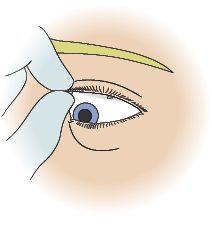
- If you locate the particle, remove it gently using the moist corner of a facial tissue, clean cloth, or cotton-tipped applicator. Do not try to remove a particle that is stuck to the eye or is located on the coloured part of the eye.
- If the casualty is wearing contact lenses, have them remove the lens before trying to remove a particle from the eye.
- Do not attempt to examine the eye if there are burns or injuries to the eyelid.
Removing a Loose Foreign Particle
To examine the eye to determine the extent and nature of injury, perform the following steps:
- Begin by asking the casualty where they feel the particle is located.
- If it feels like the particle is under the upper lid, instruct the casualty to grasp the upper eyelashes and pull the lid straight out and then down over the lower eyelashes to try to sweep the particle away.
- Try this several times. Remember to remove excess eye makeup before attempting this procedure.
- If the particle is still in the eye, try flushing it out using clean running water from a tap, an eye cup, or eye wash bottle.
- If the above methods have not been successful, you will need to examine the surface of the eye and under the lids.
If removing the particle is unsuccessful, perform the following steps:
- Warn the casualty not to rub their eye because this may cause pain and tissue damage.
- Close the casualty’s eye and cover the affected eye with an eye or gauze pad. Extend the covering to the forehead and cheek to avoid pressure on the eye.
- Secure lightly in place with a bandage or adhesive strips. Make sure there is no pressure on the eyeball.
- Give ongoing casualty care and get medical help.
First Aid for Injuries to the Soft Tissues Around the Eye
Wounds to the eyelid and soft tissue around the eye are serious because there may be injury to the eyeball. Blows from blunt objects may cause bruises and damage the bones that surround and protect the eyes.
Cover only the most seriously injured eye to avoid the increased anxiety that the casualty may experience if both eyes are covered. This leaves the casualty able to walk on their own. If both eyes must be covered due to serious injury (e.g., intense light burn from arc welding), reassure the casualty often by explaining what is being done and why. This casualty must be carried.
First Aid for Lacerations and Bruises Around the Eye
Lacerated eyelids usually bleed profusely because of their rich blood supply. A dressing on the area will usually control bleeding.
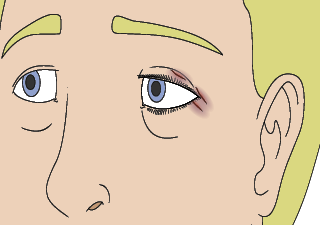
Never apply pressure to the eyeball, as this may force fluid out of the eyeball and cause permanent damage to the eye.
First Aid for an Embedded Object in or Near the Eyeball
Give first aid for an embedded object in or near the eyeball. As for any embedded object, prevent the embedded object from moving, since movement could cause further damage to the eyeball.
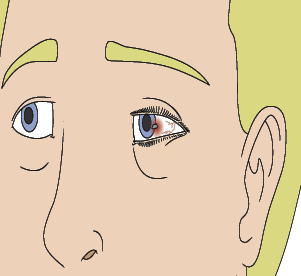
To give first aid for an embedded object in or near the eyeball, perform the following steps:
- Perform a scene survey and call 9-1-1.
- Perform a primary survey.
- Have a bystander support the head.
- Place dressings, preferably sterile, around the embedded object.
- Place padding or dressings around the object in a “log cabin” fashion, to stabilize the object.
- Make sure there is no pressure on the eyeball.
First Aid for an Extruded Eyeball
An extruded eyeball has been thrust out of its socket. Do not try to put the eye back into position.
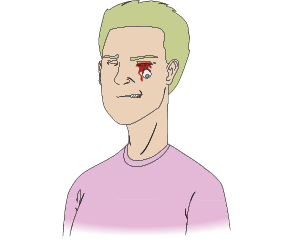
To give first aid for an extruded eyeball, perform the following steps:
- Perform a scene survey and primary survey.
- Have a bystander support the head.
- Gently cover the eyeball and socket with a moist dressing. Hold this in place with tape and more dressings.
- Give ongoing casualty care until handover.
First Aid for a Chemical Burn to the Eye
The eyes can be permanently injured by corrosive chemicals in either solid or liquid form. Casualties normally suffer intense pain and are very sensitive to light.
To give first aid for a chemical burn to the eye, perform the following steps:
- Perform a scene survey and have a bystander support the head.
- Perform a primary survey.
When working with chemicals, know where to find Safety Data Sheets (SDS) and refer to them for guidance with first aid. -
Sit or lay the casualty down. If only one eye is injured, protect the uninjured eye.
- If the chemical is a dry powder, brush away any excess off the casualty’s face with a gloved hand or cloth and remove contaminated clothing.
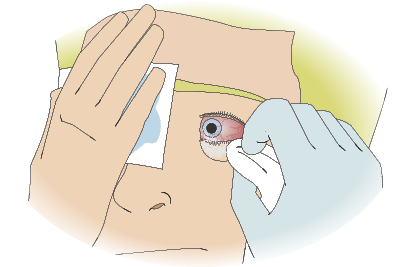
- Flush the injured eye with cool water or sterile saline solution for at least 15 minutes. Since pain may make it hard for the casualty to keep the eye open, gently open the eye with your fingers.
- Cover the injured eye with dressings. If both eyes are injured, cover the more seriously injured eye. Only cover both eyes if the casualty is more comfortable that way. Covering both eyes blinds the casualty and adds to their stress. If you do cover both eyes, keep the casualty lying down.
- Give ongoing casualty care.
- Transport the casualty to medical care for further assessment.
When working with chemicals, know where to find Safety Data Sheets (SDS) and refer to them for guidance with first aid.
Considerations for when the casualty is wearing contact lenses
Do not waste time trying to remove contact lenses. Flush the eyes for 15 minutes. This may wash out any debris from the lenses. If not, have the casualty remove them. Lenses exposed to chemicals should be thrown away (so it does not matter if they are washed away during flushing).
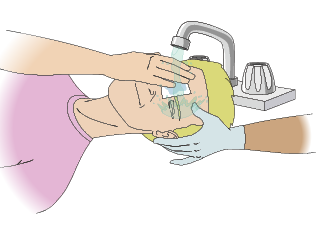
When there is a risk of eye injury from chemicals, proper eye wash equipment should be kept nearby.
First Aid for Intense Light Burns to the Eye
Burns to the eyes may be caused by prolonged exposure to intense light, such as direct or reflected sunlight, or a short duration event, like the flash from an arc welder. Snow blindness is a common injury of this kind. As with a sunburn, the casualty may not feel the tissue damage happening but will develop symptoms several hours after exposure. Signs and symptoms include:
- Sensitivity to light
- Pain
- Redness
- Watery eyes
- Blurred vision
- A gritty feeling in the eyes
To give first aid for intense light burns to the eye, perform the following steps:
- Perform a scene survey.
- Perform a primary survey.
- Cover the eyes to cool them and keep the light out. The casualty will be temporarily blinded, so reassure them often.
- Give ongoing casualty care.
- Transport the casualty to medical care for further assessment.
 |
 |