First Aid Tools
Bandages
A bandage is any material that is used to hold a dressing in place, maintain pressure over a wound, support a limb or joint, immobilize parts of the body, or secure a splint.
When using bandages, remember to:
- Apply firmly to make sure bleeding is controlled or immobilization is achieved
- Check the circulation below the injury before and after applying a bandage, you may have applied it too tightly or swelling may have made it too tight.
Triangular Bandage
A triangular bandage is a versatile item in a first aid kit. It can be used fully opened to create a sling or hold a large dressing in place. It can be folded into a broad or narrow bandage to hold splints, apply pressure, or to immobilize parts of the body.
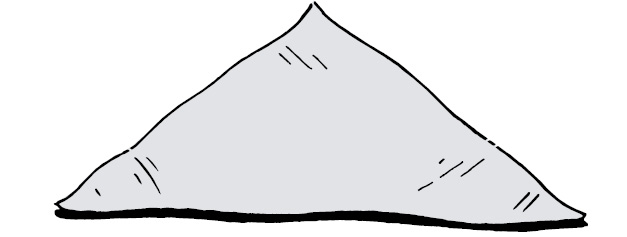
Broad and Narrow Bandage
A broad bandage is used to apply pressure over a wide area, and to immobilize the body to itself. To form a broad bandage:
- Fold the point to the centre of the base with the point slightly beyond the base.
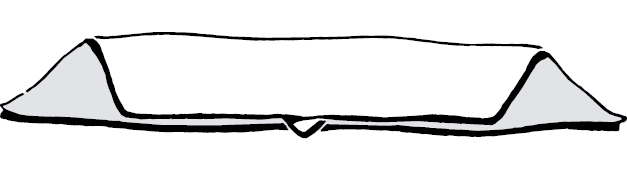
- Fold in half again from the top to the base.
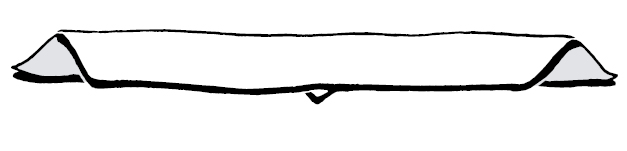
A narrow bandage is a better option for securing splints and dressings as it allows more focused pressure. To form a narrow bandage, fold a broad bandage in half again from the top to the base to form a narrow bandage.
Reef Knot
The reef knot is the best, and preferred, knot for tying bandages and slings. The reef knot lies flat, making it more comfortable than other knots; it does not slip and is easy to untie to adjust the bandage.
To tie a reef knot, perform the following steps:
- Take one end of a bandage in each hand.
- Lay the end from the right hand over the one from the left hand and pass it under to form a half-knot. This will transfer the ends from one hand to the other.
- The end now in the left hand should be laid over the one from the right and passed under to form another half-knot. The finished knot looks like two intertwined loops.
- Tighten by pulling one loop against the other or by pulling only on the ends.
- Place knots so they do not cause discomfort by pressing on skin or bone, particularly at the site of a fracture or, when tying a sling, place knot at the neck.
- If the knot is uncomfortable, place soft material underneath as padding.

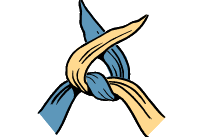

Figure 8 Knot
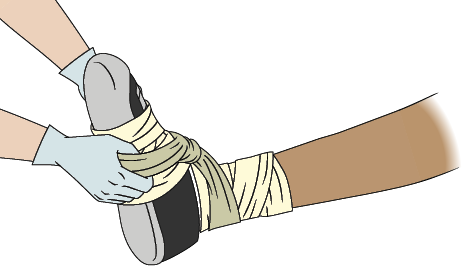
A figure 8 knot may be used to tie the ankles and feet, to secure a splint to the ankles/feet, or to support an injured ankle.
To tie a figure 8 knot, perform the following steps:
- Position the centre of a narrow or broad triangular bandage under the ankle (or both ankles if tying the feet together).
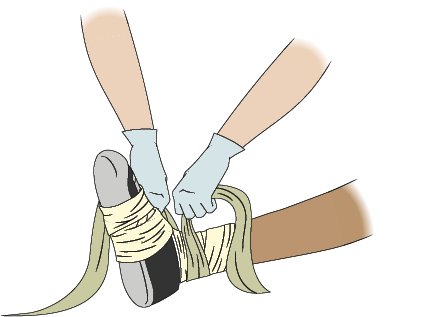
- Cross the ends over top the ankles and bring the ends around the feet and tie off.
Roller Bandage
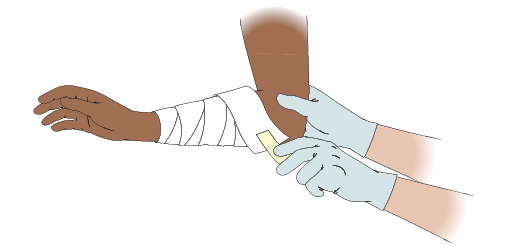
Roller bandages, usually made of gauze-like elastic material, are used to hold dressings in place or to secure splints.
Put on a roller bandage in a simple spiral. Starting at the narrow part of the limb, anchor the bandage with a few turns and continue wrapping the bandage, overlapping each turn by one quarter to one third of the bandage’s width. Make full-width overlaps with the final two or three turns and secure with a safety pin, adhesive tape, or by cutting and tying the bandage as shown. Always check circulation below the wound before and after applying a bandage, as you may have applied it too tightly, or swelling may have made it too tight.
 |
 |