First Aid Tools
Slings
A sling can be easily improvised with a scarf, belt, tie, or other item that can go around the casualty’s neck. You can also support the arm by placing the hand inside a buttoned jacket or by pinning the sleeve of a shirt or jacket to the clothing in the proper position.
An arm sling is used to support the arm and provide some elevation for injuries affecting the lower arm, wrist, and hand.
A tubular sling is used to transfer the weight of an arm to the opposite shoulder, and to provide more elevation to the hand.
A cuff-and-collar sling can support the weight of an arm when the shoulder will not allow the arm to move. The weight is supported by the neck more than the shoulder of the injured arm.
Applying an Arm Sling
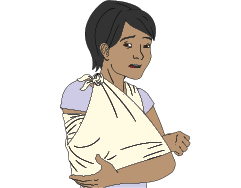
To apply an arm sling, perform the following steps:
- Ask the casualty to support the forearm of their injured arm horizontally across their body.
- Place an open triangular bandage between the forearm and the chest so the triangle’s top point is supporting the elbow.
- With the casualty still supporting their injured arm, bring the remaining two free points of the bandage over the hand and forearm, and join them around the back of the neck on the injured side.
- Tie off the sling on the injured side with a reef knot positioned in the hollow above the collarbones.
- Place padding under the knot for comfort.
- At the elbow, twist the top point of the triangular bandage into a ‘pigtail’ and tuck it inside the sling.
- Adjust the sling as necessary to maintain access to the fingers to check circulation.
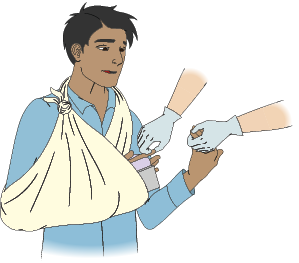
Applying a Tubular Sling
To apply a tubular sling, perform the following steps:
- Support the forearm of the injured side diagonally across the chest, with the fingers pointing toward the opposite shoulder.
- Place an open triangular bandage over the forearm with the base facing down and following the forearm about 10 cm (3 inches) below the arm. The point should extend beyond the injured arm.
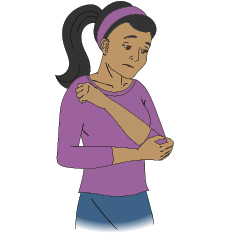
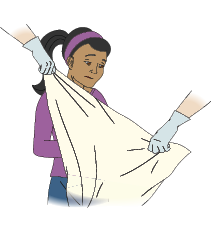
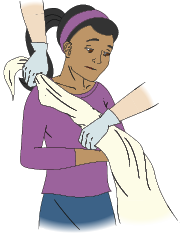
- Ease the base of the bandage under the hand, forearm, and elbow and tuck the base of the bandage under the injured arm to make a pocket that runs the full length of the arm.
- Gather the bandage at the elbow by twisting it toward the back.
- Bring the lower end around the back and between the shoulder blades, then over the shoulder on the uninjured side. This closes the pocket at the elbow.
- Gently adjust the height of the arm as you tie off the ends of the bandage so the knot rests in the natural hollow above the collarbone.
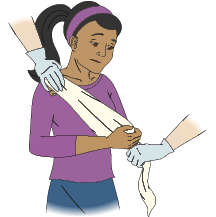
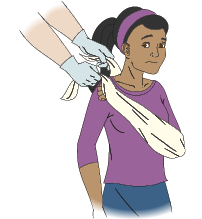
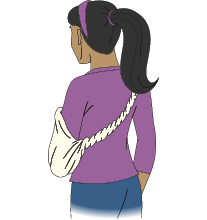
- Place padding under knot, if available. Tie the sling tightly enough to support the weight of the injured arm.
Applying a Cuff and Collar Sling
To apply a cuff-and-collar sling, perform the following steps:
- Fold a triangular bandage into a narrow bandage.
- Centre the bandage at the wrist and bring both ends up on either side, tying a half-knot.
- Bring the ends of the bandage up to the neck and tie off.
 |
 |