Head and Spinal Injuries
Concussion
A concussion is a temporary disturbance of brain function, usually caused by a blow to the head or neck. The casualty may become unconscious but usually for only a few moments. The casualty usually recovers quickly, but there is a chance of serious brain injury.
When the head is in motion and stops suddenly (such as hitting the ground or another person), the brain inside continues to move for a moment and then hits the inside of the skull. It is possible the brain will even bounce off the inside of the skull and then hit another part of the skull.
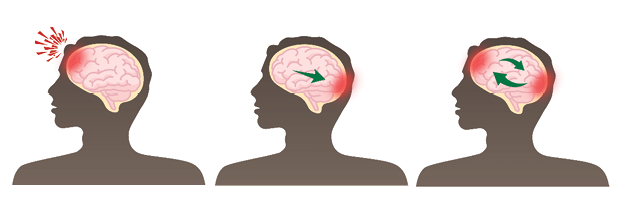
When assessing for signs and symptoms of a concussion, it is important to remember that they may not appear right away and could be harder to identify. The signs and symptoms of a milder concussion may be dismissed as another problem.
|
Signs and Symptoms of a Concussion |
|
|
Mild Concussion |
Severe Concussion |
|
NOTE: These signs and symptoms may appear several hours after the incident. |
|
|
|
First Aid for a Concussion
Consider the mechanism of injury and whether spinal immobilization precautions should be taken. Assess the casualty to determine the possible severity. A casualty who has lost consciousness needs medical attention. Call 9-1-1.
For a mild concussion with no loss of consciousness and only mild signs and symptoms (slight memory loss, headache, slight dizziness), the casualty should be seen by a doctor as soon as possible, within 24 hours of the injury.
For a moderate concussion without a loss of consciousness, and demonstrating moderate signs and symptoms (difficulty remembering, headache, blurred vision, etc.), the casualty should be seen by a doctor within a few hours of the injury.
For a severe concussion with any loss of consciousness, or demonstrating severe signs and symptoms (confusion, nausea and vomiting, sensitivity to light, very slow to get up), call 9-1-1 to have the casualty taken to hospital by EMS.
 |
 |