CPR and AED
Adult CPR
Cardiopulmonary Resuscitation (CPR) is artificial circulation and artificial respiration. The artificial circulation causes blood to flow through the body while the artificial respiration provides oxygen to the lungs.
The purpose of CPR is to circulate enough oxygenated blood to the brain and other organs to delay damage until either the heart starts beating again, or medical help takes over from you. CPR is most effective when interruptions to chest compressions are minimized.
Performing One-Rescuer CPR
To perform one-rescuer CPR, perform the following steps:
- Perform a scene survey.
- Assess responsiveness.
- Send someone to call 9-1-1 and get an AED if available.
- Perform a primary survey.
- Open the airway.
- Check for breathing for at least 5 and no more than 10 seconds.
- If the casualty is not breathing, or not breathing effectively (agonal breaths), begin compressions immediately.
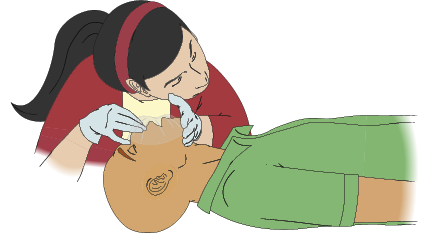
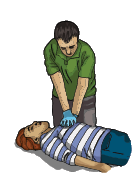
- Give 30 compressions. Push hard. Push fast.
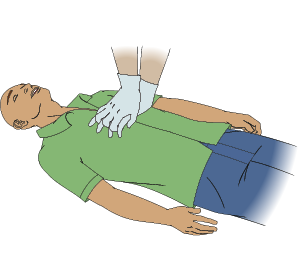
- Position your hands in the centre of the upper chest and your shoulders directly over your hands. Keep your elbows locked.
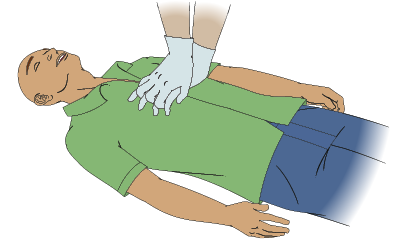
- Press the heels of the hands straight down on the breastbone. The depth of each compression should be at 5 to 6 cm (2 to 2.4 inches).
- Release pressure and completely remove your weight at the top of each compression to allow the chest to return to the resting position.
- Give compressions at a rate of 100 to 120 per minute. Count compressions out loud to keep track of how many you have given, and to help keep a steady rhythm.
- Position your hands in the centre of the upper chest and your shoulders directly over your hands. Keep your elbows locked.
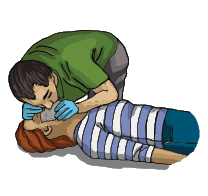
- Open their airway using a head-tilt/chin-lift.
- Position a barrier device and give 2 ventilations.
- For an adult casualty, each breath should take about 1 second, with just enough air to make the chest rise.
This is one cycle of 30:2 (30 compressions to 2 ventilations).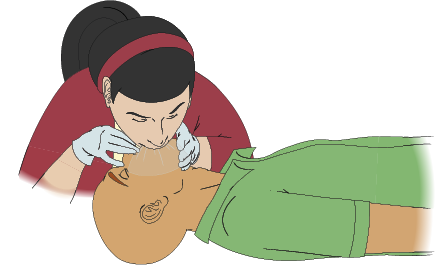
- For an adult casualty, each breath should take about 1 second, with just enough air to make the chest rise.
- Continue CPR until:
- An AED is applied
- The casualty begins to respond
- Another first aider or medical help takes over
- You are too exhausted to continue.
An AED should be applied as soon as it arrives at the scene.
Taking over CPR from another rescuer
To take over CPR from another rescuer, perform the following steps:
- Ensure medical help has been called.
- Offer to help. Tell the rescuer that you are trained in CPR.
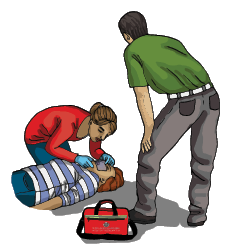
- Give 30 compressions followed by 2 breaths. Use your own barrier device if available.
Chest-Compression-Only CPR
CPR guidelines stress early recognition of the emergency and stress the importance of calling 9-1-1 or the local emergency number if you find someone collapsed and unresponsive.
If you have not been trained in CPR or are hesitant to perform ventilations for any reason, don’t give up. Your actions can still save a life.
Compression-only CPR is CPR without mouth-to-mouth breaths. Provide high quality chest compressions by pushing hard and fast on the centre of the chest, at a rate of 100 to 120 compressions per minute.
Although this does not give the casualty any oxygen, this option can be used by people not trained in conventional CPR, or those who are unsure of their ability.
Dispatcher-Assisted CPR
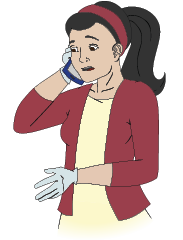
In many locales, the 9-1-1 dispatcher is trained to coach you through an emergency until medical help arrives. Put your phone on speaker and place it by the casualty’s head and talk to the dispatcher throughout the rescue.
Performing Two-Rescuer CPR
If two trained rescuers are available, they can cooperate to perform CPR on a casualty. There are three advantages to two rescuers performing CPR as a team:
- CPR is a strenuous physical activity and as a first aider gets tired, the quality of the chest compressions will deteriorate. By sharing the task of compressing the chest, two rescuer CPR allows a team to perform effective chest compressions for a longer period.
- Two-rescuer CPR minimizes the time the compressions are interrupted for ventilations to be given.
- Two-rescuer CPR allows the rescuers to give feedback and support each other during a stressful event.
To perform two-rescuer CPR, the first aider who performs the primary survey stays at the casualty’s head, keeping the airway open and ventilating after 30 compressions. The second rescuer will compress the chest.
To maintain effective compressions, it is recommended that rescuers switch roles after every 5 cycles of compressions and ventilations (approximately 2 minutes).
 |
 |