Appendix - The Body and How it Works
Respiratory system
The respiratory system causes air to be drawn in and out of the lungs. The fresh air we breathe contains about 21% oxygen. In the lungs, blood picks up some of the oxygen and releases carbon dioxide. The air we breathe out has less oxygen (about 16%) and more carbon dioxide.
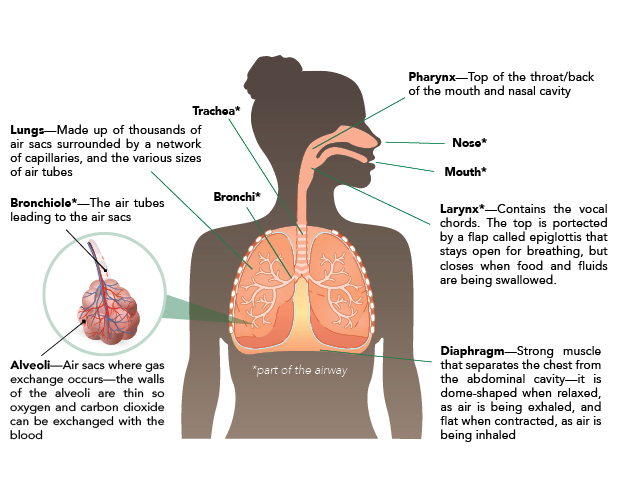
The respiratory system has three main parts: the airway, the lungs and the diaphragm. The airway is the passage that air follows to get from the nose and mouth to the lungs. In the lungs, blood drops off carbon dioxide and picks up oxygen. This process is called gas exchange. The diaphragm, a smooth, flat muscle just below the lungs, is used in breathing.
Respiratory Control
Breathing is controlled by the respiratory centre in the brain, located near the base of the neck. It monitors the amount of oxygen and carbon dioxide in the blood. As the levels of oxygen and carbon dioxide change, the respiratory centre responds by changing the rate and depth of breathing.
How much oxygen is used, and how much carbon dioxide is given off, is related to the person’s level of physical activity and stress. As physical activity goes up, or illness or injury is present, more oxygen is used and more carbon dioxide is given off, so the respiratory centre increases the rate and depth of breathing to compensate (the heart rate also goes up). Breathing slows down when less oxygen is needed and less carbon dioxide is being produced.
Mechanism of Breathing
The lungs have no way of drawing air into themselves. Instead, the diaphragm and the muscles between the ribs work together to expand the chest, which in turn expands the lungs. This causes air to be pulled into the lungs.
As the breathing muscles relax, the chest returns to its smaller size and air is forced out of the lungs.
The lungs are covered with a smooth, slippery tissue called the pleural membrane. It is a continuous, double-layered tissue, one layer attached to the lungs and the other to the inside of the chest wall. The pleura acts as a lubricating layer to allow easy movement between the chest wall and the lungs, and to ensure that the lungs expand with the action of the chest wall.
 |
 |