Appendix - The Body and How it Works
Circulatory System
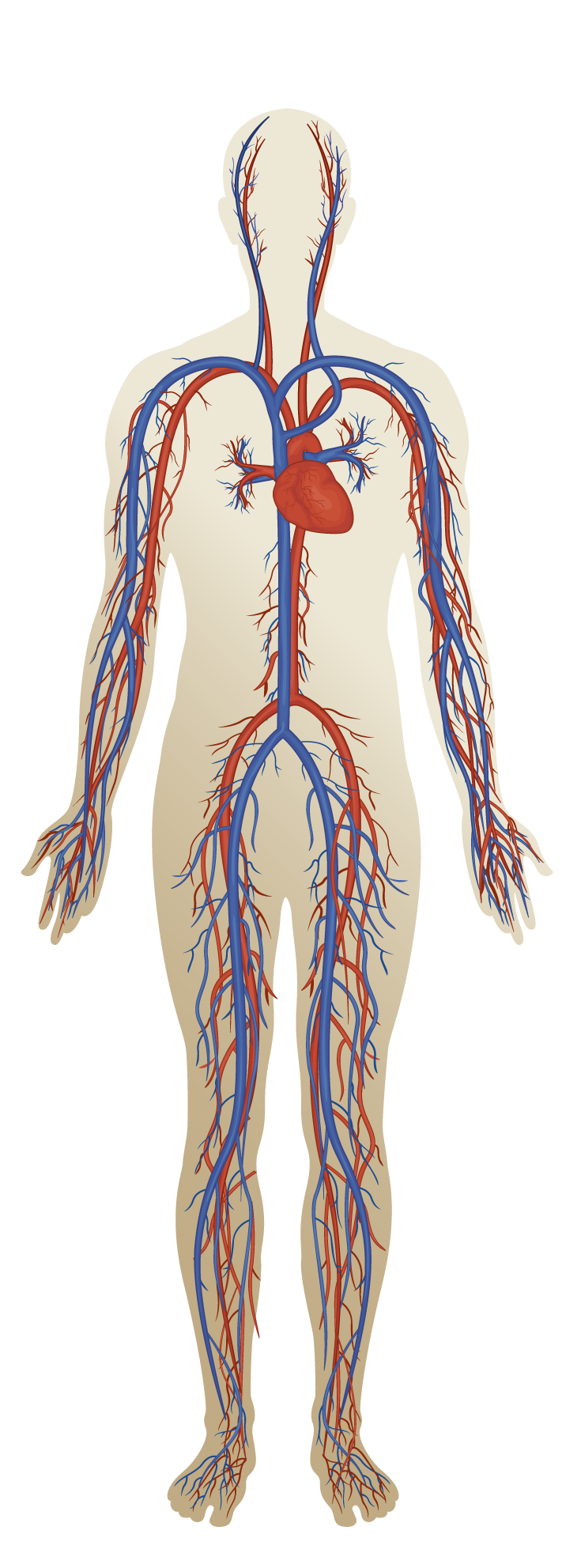
The circulatory system is a complex closed circuit that circulates blood throughout the body. It consists of the heart and blood vessels. Blood circulation
is essential for distributing oxygen and nutrients to cells, and for collecting waste products from cells for excretion from the body.
Heart
The heart is a muscle located in the chest cavity behind the ribs and sternum. This muscle is a hollow muscular organ that allows the blood in the body to circulate. The heart functions as a pump for the rest of the body, continually pumping blood to the lungs and then to the rest of the body. The heart has chambers that fill with blood when it relaxes. Once contracted the blood will be pushed out into the blood vessels. The pulse rate is measured by counting how many times the heart pumps in one minute.
To make the heart beat effectively, it has a complex system of nerves. These nerves carry electrical impulses that control the beating of the heart.

Blood Vessels
The blood travels through blood vessels. There are three main types of blood vessels: arteries, capillaries and veins. The arteries are the strongest blood vessels. They carry blood, under pressure, from the heart to all parts of the body. The arteries expand according to the volume of blood being forced through them by the pumping action of the heart, and return to normal size as the heart refills for the next contraction. This pressure wave can be felt as a pulse.
The largest artery, the aorta, emerges from the top of the heart. The coronary arteries branch off from the top of the aorta to supply the heart with blood. The smallest arteries are called arterioles and eventually form capillaries. Capillaries are the tiny blood vessels that reach every living cell to deliver oxygen, food, etc., and collect waste products. They have very thin walls to allow for the exchange of fluids and gases. Capillaries eventually join to form tiny venules, which in turn form veins. The veins take the blood back to the heart. Veins have thinner walls than arteries and most have cup-like valves that allow blood to flow only toward the heart.
Blood
Blood is the fluid that circulates through the heart and blood vessels. It transports oxygen and nutrients to the cells and carries away carbon dioxide and other waste products. Blood is composed of plasma, red cells, white cells and platelets.
Blood circulation
The blood circulation system is a closed loop beginning and ending at the heart. It consists of:
Pulmonary circulation – Starting at the right side of the heart, blood is pumped to the lungs, where it drops off carbon dioxide and picks up oxygen, and then moves it back to the left side of the heart.
Systemic circulation – Starting at the left side of the heart, blood is pumped to the body, where it delivers oxygen and picks up carbon dioxide, and then moves it back to the right side of the heart.
Blood components
The components that comprise blood include:
- Plasma – Pale yellow liquid that carries cells, platelets, nutrients and hormones
- Red blood cells – Carry oxygen
- White blood cells – Protect the body against microbes
- Platelets – Help form blood clots to stop bleeding
Blood pressure
Blood pressure is the pressure of the blood pushing against the inside walls of the blood vessels. With each heartbeat, there is a wave of pressure that travels throughout the circulatory system.
The pressure wave is strong enough to be felt as a pulse at various points in the body, including the wrist (radial pulse), the neck (carotid pulse), and the upper arm (brachial pulse). Three factors control blood pressure, and problems with one or more cause shock:
- Blood volume (how much blood is in the body)
- The capacity and elasticity of the blood vessels
- The strength of the heartbeat
If blood pressure is too low, the body’s tissues don’t get enough oxygen. This results in shock. Severe bleeding reduces the blood volume, which affects blood pressure. The body tries to compensate for blood loss by constricting the blood vessels and reducing the capacity of the circulatory system. With continued blood loss, however, the body cannot compensate and blood pressure drops.
 |
 |