BLS+CPR for Healthcare Providers
CPR
When assessing the casualty, the HCP (healthcare provider) will check for breathing and a pulse simultaneously before beginning compressions. Rescuers should check the:
- Adult – Carotid pulse
- Child – Carotid or femoral pulse
- Infant – Brachial or femoral pulse
Chest Compression FractionThe chest compression fraction is the estimate of time during the CPR event that the casualty receives chest compressions. The goal is to minimize the time compressions are not being performed (the “time off the chest”) to increase blood circulation to the vital organs during CPR. The target goal is 60% to 80% of the time performed on rescue chest compressions. |
Bradycardia (slow pulse rate)
Bradycardia is a slow heart rate. A child or infant with with a pulse rate of less than 60 beats per minute and showing signs of poor perfusion/circulation, despite oxygen and ventilation, should also receive chest compressions. The low heart rate (<60 bpm) does not provide enough circulation to sustain adequate cellular oxygenation; by providing a compression rate of 100 to 120 compressions per minute, the healthcare provider will assist in providing adequate circulation to a casualty.
CPR (Compression and Ventilation) Ratios
Healthcare providers will provide the same compression to ventilation ratios as the lay rescuer when performing one-rescuer CPR for adults, children and infants; as well as two-rescuer adult, but the ratio will change when they perform two-rescuer CPR for the child and infant.
For two-rescuer CPR on a child or infant, the rescuer will provide compressions and ventilations at a ratio of 15 compressions to 2 ventilations.
The depth of compressions should be at least 1/3 the depth of the infant or child’s chest with a rate of 100 to 120 compressions per minute.
In the case of the infant casualty, the rescuer may encircle the infant casualty’s chest and use their thumbs side by side or one on top of the other to provide compressions. The method used will depend on the size of the infant casualty and the rescuer’s thumbs.
Adult CPR/AED
Check breathing and pulse for at least 5 and no more than 10 seconds.
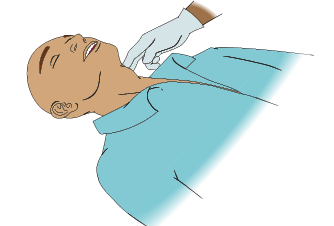
If there is a pulse, but no breathing, begin artificial respiration.
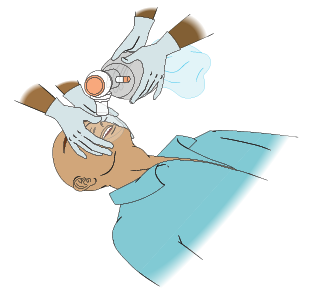
If there is no pulse and no breathing, or only agonal breaths, begin compressions.
Agonal breathing is an abnormal pattern of breathing driven by a brain-stem reflex, characterized by irregular gasping respirations, at times accompanied by strange vocalizations. They can occur with cardiac arrest and lead bystanders to believe the casualty is breathing.
One-rescuer CPR 30:2
To provide one-rescuer CPR at a ratio of 30:2, perform the following steps:
- Give 30 chest compressions in the middle of the upper chest using two hands.
- Push hard, push fast (100 to 120 per min) to a depth of 5 to 6 cm (2 to 2.4 inches). The pressure and release phases take the same time. Release pressure and completely remove your weight at the top of each compression to allow the chest to return to the resting position after each compression. Minimize interruptions.
- Give 2 breaths.
- Continue CPR at a ratio of 30:2 until any of the following occurs:
- An AED is ready for use.
- EMS/advanced providers arrive.
- The casualty shows signs of recovery.
Two-or-more-rescuer CPR 30:2
To provide two-or-more-rescuer CPR at a ratio of 30:2, perform the following steps:
- Rescuer one gives 30 chest compressions at a rate of 100 to 120 per minute.
- Rescuer two gives 2 rescue breaths, enough to make the chest visibly rise. Minimize interruptions.
- Quickly change positions every 5 cycles (2 minutes).
- If an advanced airway is in place, give one breath every 6 to 8 seconds, with no pause in compressions for breaths.
Defibrillation
To provide defibrillation on an adult, perform the following steps:
- Expose the chest. Turn on the AED. Follow the voice prompts. Select and attach the adult pads.
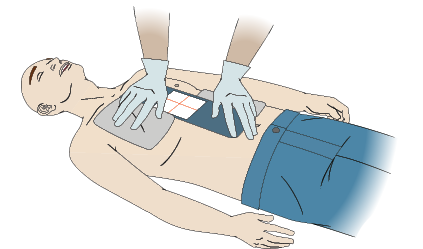
- If SHOCK is advised, CLEAR and give 1 shock. Immediately resume chest compressions.
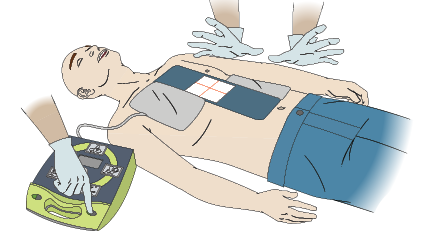
- If NO SHOCK is advised, immediately resume chest compressions.
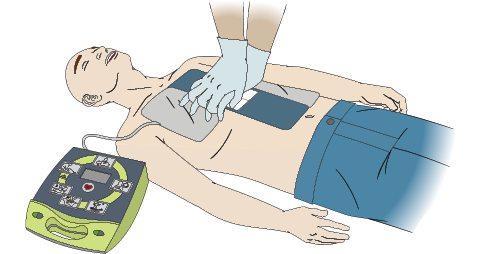
- Continue 30 compressions of 2 breaths for 5 cycles (approximately 2 minutes). Analyze heart rhythm, and continue CPR/AED until advanced providers take over.
Child CPR/AED
Check breathing and pulse for at least 5 and no more than 10 seconds.
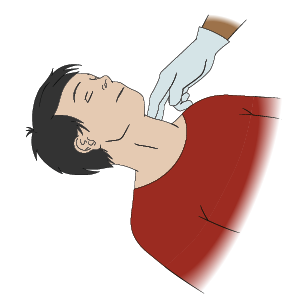
If there is a pulse, but no breathing, begin artificial respiration.
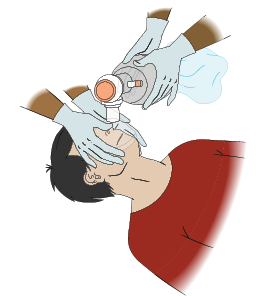
If there is no pulse (or it is below 60 bpm) and no breathing, or only agonal breathing, begin compressions.
Perform the following procedures for one-rescuer and two- or more rescuer CPR/AED for a child.
One-rescuer CPR 30:2
To provide one-rescuer CPR at a ratio of 30:2 for a child, perform the following steps:
- Give 30 chest compressions in the middle of the upper chest using one or two hands.
- Push hard, push fast (100 to 120 per min) to a depth of about 2 inches (5 cm), or about 1/3 of the depth of the chest. The pressure and release phases take the same time. Release pressure and completely remove your weight at the top of each compression to allow the chest to return to the resting position after each compression. Minimize interruptions.
- Give 2 breaths.
- Continue 30 compressions to 2 breaths.
Two-or-more-rescuer CPR 15:2
To provide two-or-more-rescuer CPR at a ratio of 15:2 for a child, perform the following steps:
- Rescuer one gives 15 chest compressions at a rate of at least 100 to 120 compressions per minute.
- Rescuer two gives 2 rescue breaths, enough to make the chest visibly rise.
- Quickly change positions every 10 cycles (2 minutes).
- If an advanced airway is in place, give one breath every 6 to 8 seconds without a pause in compressions.
Common Problems While Performing CPRVentilation:
|
Defibrillation
To provide defibrillation on a child, perform the following steps:
- Expose the chest. Turn on the AED. Follow the voice prompts. Select and attach the pediatric pads. If pediatric pads are not available, use adult pads.
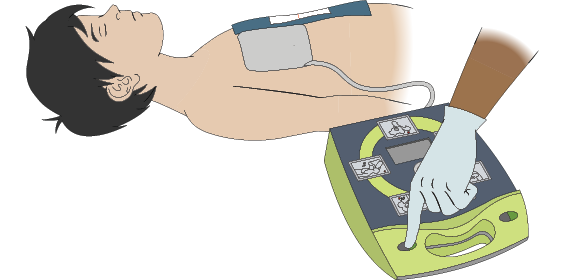
- If SHOCK is advised, CLEAR and give 1 shock. Immediately resume chest compressions.
- If NO SHOCK is advised: Immediately resume chest compressions.
- Continue 15 compressions at 2 breaths for 5 cycles (approximately 2 minutes). Analyze heart rhythm, and continue CPR/AED until advanced providers take over.
AED Special CircumstancesPregnant women: AEDs can be used in all stages of pregnancy |
Infant CPR/AED
Check breathing and pulse for at least 5 and no more than 10 seconds. For infants, you will check the pulse at the brachial (inner arm around the elbow crease) or femoral (crease of the groin on either leg) arteries, and not the carotid arteries.
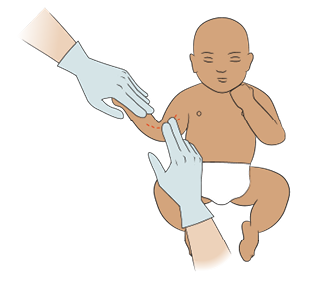
If there is a pulse, but no breathing, begin artificial respiration.
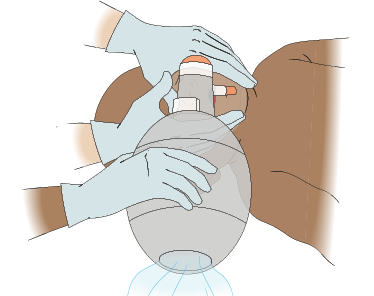
If there is no pulse (or it is below 60 bpm) and no breathing, or only agonal breathing, begin compressions.
Perform the following procedures for one-rescuer and two- or more rescuer CPR/AED for an infant.
One-rescuer CPR 30:2
To provide one-rescuer CPR at a ratio of 30:2 for an infant, perform the following steps:
- Give 30 chest compressions just below the nipple line using two fingers.
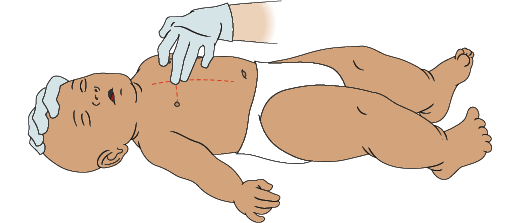
- Push hard, push fast (100 to 120 per minute) to a depth of about 1 1/2 inches (4 cm) or 1/3 of the depth of the chest. The pressure and release phases take the same time. Release pressure and completely remove your weight at the top of each compression to allow the chest to return to the resting position after each compression. Minimize interruptions.
- Give 2 breaths.
- Continue 30 compressions: 2 breaths.
Two-or-more-rescuer CPR 15:2
In the case of the infant casualty, the rescuer may encircle the infant casualty’s chest and use their thumbs side by side or one on top of the other to provide compressions. The method used will depend on the size of the infant casualty and the rescuer’s thumbs.
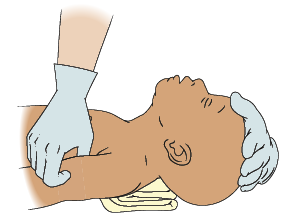
To provide two-or-more-rescuer CPR at a ratio of 15:2 for an infant, perform the following steps:
- Rescuer one gives 15 chest compressions at a rate of at least 100 to 120 compressions per minute.
- Rescuer two gives 2 rescue breaths, enough to make the chest visibly rise.
- Quickly change positions every 10 cycles (2 minutes).
- If an advanced airway is in place, give one breath every 6 to 8 seconds without a pause in compressions.
Defibrillation
To provide defibrillation on an infant, perform the following steps
- Expose the chest. Turn on the AED. Follow the voice prompts. Select and attach the pediatric pads. If pediatric pads are not available, use adult pads.
- SHOCK advised: CLEAR and give 1 shock. Immediately resume chest compressions.
- NO SHOCK advised: Immediately resume chest compressions.
- Continue 15 compressions - 2 breaths for 5 cycles (approximately 2 minutes). Analyze heart rhythm, and continue CPR/AED until advanced providers take over.
Team Approach
Healthcare providers should practise working in integrated teams. When a team is available, one rescuer provides airway control and ventilations right away, a second rescuer begins compressions, and a third obtains and uses the AED. This is the optimal situation, as the rescuers have the ability to maximize the compression fraction of CPR prior to defibrillation. A high-performance team can achieve an 80% compression fraction (i.e.: perform effective chest compressions for the majority of the time they are resuscitating the casualty).
Post-Resuscitation Care
After the CPR incident is over, if the circulation returns, the casualty will need to be monitored closely. If defibrillator pads have been attached, they should be kept on the chest. Check for vital signs every 2 minutes. If the casualty is not breathing or not breathing effectively, assist or provide ventilation.
 |
 |