Major Wound Care
Severe External Bleeding
Severe external bleeding (also reffered to as external hemorrhages) is the escape of blood from the blood vessels. In external bleeding, blood escapes the body through a surface wound. In internal bleeding, blood escapes from tissues inside the body.
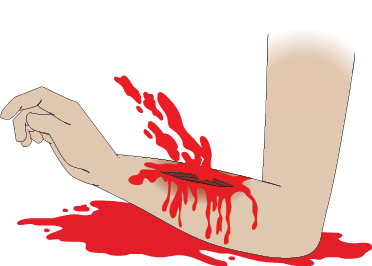
In arterial bleeding, the blood is bright red and spurts with each heartbeat.
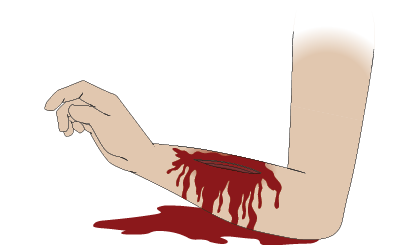
In venous bleeding, the blood is dark red and flows more steadily.
Severe blood loss will result in the following signs and symptoms of shock:
- Cool, clammy skin that lacks colour
- Rapid pulse that gradually becomes weaker
- Faintness, dizziness, thirst, and nausea
- Restlessness and apprehension
- Shallow breathing, yawning, sighing, or gasping for air
First Aid for Severe External Bleeding
When caring for any wounds involving bleeding, check the circulation before and after you bandage the injury.
To check for circulation, perform the following steps:
- Check the temperature of the skin below the injury.
- Depress the fingernail or toenail until the nail bed turns white. Release the pressure and note how quickly the colour returns. This can be used anywhere on the body if the nails are not easily accessible.
To give first aid for a severe external bleed, perform the following steps:
- Perform a scene survey, then perform a primary survey.
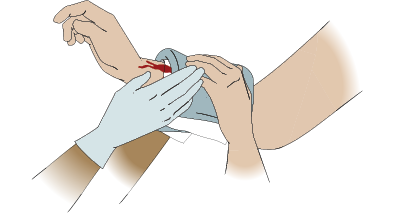
- To control severe bleeding, apply direct pressure to the wound.
- Place the casualty at rest.
- Once bleeding is under control, continue the primary survey, looking for other life-threatening injuries.
- Before bandaging the wound, check circulation below the injury.
- Bandage the dressing in place.
- Check the circulation below the injury and compare it with the other side. If it is worse than it was before the injury was bandaged, loosen the bandage just enough to improve circulation if possible.
- Give ongoing casualty care.
If the dressings become blood-soaked, do not remove them. Add more dressings and continue pressure. Removing the blood-soaked dressings may disturb blood clots and expose the wound to further contamination.
Tourniquets
A tourniquet is a device designed to stop bleeding by compressing an artery or vein against the bone of a limb. Often considered a tool of last resort, experience and research from Afghanistan and Iraq have demonstrated the life-saving benefits of a tourniquet in traumatic bleed situations.
When to use a tourniquet
Tourniquets are an available tool, and their use depends on the situation and the injuries presented.
Two situations where a tourniquet will almost always be needed are:
- Severe amputations where the injury is not clean and not controllable with direct pressure. Amputations caused by shearing forces (such as a motor vehicle collision (MVC)), explosions, or other amputations that result in a mangled wound.
- Gunshot wounds that hit major blood vessels deeper in the limb. These are identified by either spurting bright blood or rapid loss of dark blood.
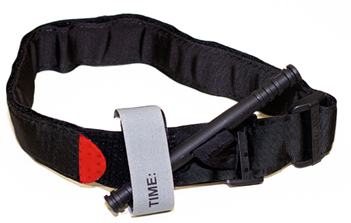
There are different types of tourniquets available. However, the most common that a first aider will encounter is the windlass tourniquet. The windlass tourniquet consists of a band, a rod (the windlass), and a locking clip.
When not to use a tourniquet
Tourniquets should not be used in the following situations:
- Minor bleeding should be treated with direct pressure and placing the casualty at rest. Applying a tourniquet in this instance will provide no more benefit than conventional bleeding controls and increases the risk of tissue damage and limb loss.
- Non-severe amputations are amputations that result in a relatively clean cut (e.g., from a saw). These amputations can usually be controlled by direct pressure over the end of the injured limb. However, if direct pressure does not work, a tourniquet can be used.
- Small gunshot wounds, such as those from small-calibre bullets, tend to bleed less and are often controllable with direct pressure.
Applying a windlass tourniquet
Since a tourniquet stops all blood flow below the application site, there is a risk that tissue below the site will die. Tourniquets should be placed as close to the wound as possible.
To apply a windlass tourniquet, perform the following steps:
- Wrap the band around the limb and feed it through the tourniquet.
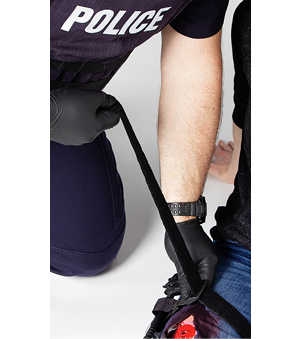
- Secure the band so it is snug against the skin – you should not be able to get two fingers under the band.
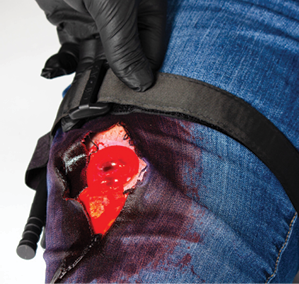
- Twist the windlass rod until the tourniquet is tight enough to stop the bleeding.
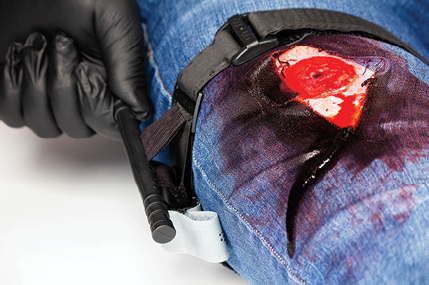
- Secure the windlass rod.
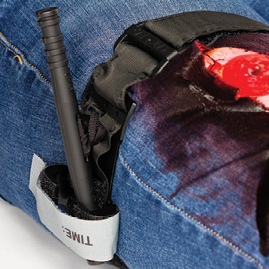
- Record the time the tourniquet was applied.
A tourniquet is not comfortable. The casualty will likely complain that the tourniquet hurts when it is properly applied.
Once applied, a tourniquet should not be loosened unless you are properly trained and in an extended care situation.
Complications of tourniquets
Tissue death is possible when using a tourniquet. A casualty who has had a tourniquet applied needs medical attention as soon as possible.
It is possible that a single tourniquet will not be enough to stop bleeding. In that situation, a second tourniquet should be applied 5 cm above the first.
Improvising a tourniquet
Overall, an improvised tourniquet is not recommended. Ideally, a tourniquet should be commercially made, as it will provide the best results. However, in cases where a commercial tourniquet is not available, and because first aid is about providing care to the best of your abilities with readily available materials, a tourniquet can be improvised with readily available materials.
To improvise a tourniquet, you will need a band and a windlass.
- Band: A narrow bandage works well, as would any piece of cloth that is reasonably narrow (about 7.5 cm or 3 inches wide) and can be easily twisted.
- Windlass: A sturdy rod that will not bend or break under pressure. It should be about 15 cm or 6 inches long.
A second bandage will be needed to secure the ends of the windlass once the tourniquet has been tightened.
An improvised tourniquet should only be used when the time between application and care at a hospital is short, as there is a greatly increased risk of damaging tissues with an improvised tourniquet.
 |
Note: Items such as belts do not make good tourniquets as they cannot be tightened enough to control bleeding. Also, a towel or t-shirt is not the best approach to control bleeding, but may be used as a last resort. Any improvised tourniquet will be replaced by something more appropriate when the paramedics arrive. |
Haemostatic Dressings
Another option for controlling bleeding is a haemostatic dressing. These dressings are impregnated with agents designed to make clotting easier and faster. Injuries where a tourniquet may be considered are also candidates for a haemostatic dressing. As well, severe bleeding on the core of the body (where a tourniquet cannot be used) may do well with this type of dressing.
A haemostatic dressing is applied the same way a pressure dressing is applied.
 |
 |