Introduction to First Aid
Safety and Personal Protection
In any emergency, first aid providers must always be aware of workplace hazards and risks and give first aid safely.
Hazards are psychological, environmental, and physical sources of potential harm, injury or death to the first aider. Examples of workplace hazards include occupational stress, extreme temperature exposure and workplace violence.
A risk is the probability of being harmed or injured given an exposure to a hazard. For example, a physical hazard may be working at a height (e.g., on a ladder), and the risk is the likelihood of falling and sustaining an injury.
There are three basic types of hazards and risks to be aware of:
- The energy source that caused the original injury: Is the mechanism that caused the original injury still active, causing injury to others? Example: Where an injury has been caused by machinery, is the machinery still running?
- There may be hazards caused by external factors. Example: Passing vehicles may pose a risk at the scene of a motor vehicle incident.
- There may be hazards associated with first aid procedures or a rescue. Example: Moving a heavy casualty could place the first aider at risk of injury.
Some hazards can be controlled by the first aid provider. When controlling hazards, keep the following principles in mind:
- Use mechanical means whenever possible (broom, dustpan, tools, etc.).
- Be careful when lifting or moving objects on or near a casualty.
- Have someone assist you where possible.
- Turn on lights where no other risks to doing so exist.
- Ensure safe footing - many injuries to first aiders are a result of slips and falls.
Hazards that require specialized training to control (electrical hazards, fire, gases, etc.) should only be controlled by those who are properly trained. Most workplaces that deal regularly with these types of hazards will have a specialized response team. Refer to your workplace’s policies and protocols.
When dealing with chemical hazards, a Safety Data Sheet/Material Safety Data Sheet (SDS/MSDS) should be accessible and will provide information on how to control the hazards, along with first aid directions.
As a workplace first aider, it is important to survey the scene for hazards, assess the hazards for the level of risk, identify appropriate controls to mitigate or eliminate the risk, and then ensure the controls are implemented.
Preventing Infection
As a first aider, you want to avoid becoming infected by something a casualty may have, as well as avoid infecting them. More information on cleaning wounds and preventing infections is covered in Chapter 8. To protect yourself from infection from the casualty, it helps to understand pathogens and the way infections transfer.
Airborne pathogens
The following are examples of infections that can be spread through the air:
- Meningitis is a bacterial or viral infection which causes swelling that affects the spinal cord and brain.
- Tuberculosis is a bacterial infection that primarily affects the lungs, but can affect any part of the body.
- Influenza, or “the flu,” is a viral infection that is easily spread, and can vary from being mildly debilitating to fatal.
Fluid and blood-borne pathogens
Exposure to blood or body fluids (e.g., vomit, feces) poses a health risk to first aiders.
There are three diseases that first aiders should be aware of:
- Human Immunodeficiency Virus (HIV) is the virus responsible for AIDS. There is no vaccine to protect people from this virus. The best defence remains adequate protection to help prevent infection.
- Hepatitis B is one of the three common forms of hepatitis, a viral disease that can cause severe liver damage. Some people who have Hepatitis B have no symptoms but are still contagious. There is a vaccine to prevent Hepatitis B.
- Hepatitis C causes much of the same liver damage as Hepatitis B, but there is currently no vaccine available to prevent this disease.
Chain of Infection
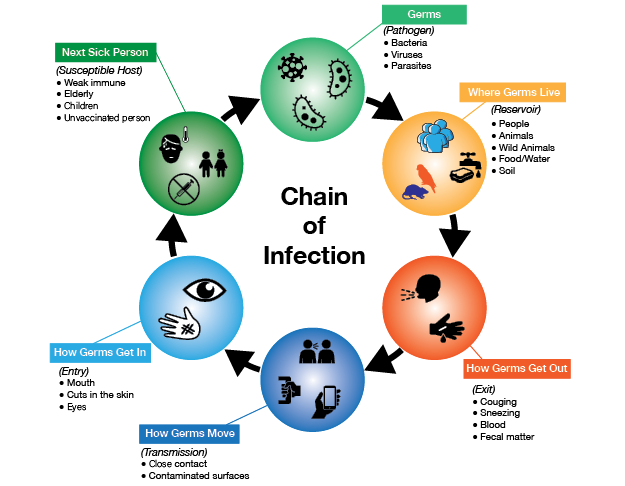
The Chain of Infection is a way of understanding the cycle of infection. Disrupting any point in the chain can help break the cycle of infection and potentially stop further infections.
Pathogens – Comprised of bacteria, viruses, and parasites. These are what actually make people sick. They can be new or a mutation of an existing pathogen.
Reservoirs – Where pathogens live before moving around. Common reservoirs are animals, food and water, soil, or other people. Contaminated water is one of the most frequent reservoirs.
Exit – How the pathogen leaves the reservoir. When infections transfer between people, the common exit paths are coughing, sneezing, blood, or fecal matter.
Transmission – How the pathogen moves from one location to another. This can be through close contact with an infected person, or via contaminated surfaces (called fomites).
Entry – How the pathogen enters the next host. This can occur through the mouth (eating or drinking), the eyes or nose (mucous membranes), or breaks in the skin (cuts or injection).
Susceptible Host – The potential new host must be susceptible to the pathogen for it to take hold. Often it is the elderly and children who are susceptible. In some cases, vaccinations can prevent infection, and a lack of vaccination will provide a susceptible host.
A cold virus is a common infection that impacts people every year. Following the chain, it starts in a sick person and exits through coughing and sneezing. It will travel from one person to another through close contact or droplets left on a surface (like a doorknob). The next host touches the contaminated surface and then touches their mucous membranes (nose, mouth, eyes) before washing their hands. Because the host has not encountered this particular variant of the cold before, they are susceptible and become infected. Once in the new host, the virus may change slightly, or simply be carried, starting the whole process again.
Sharp objects
If a sharp object touches infected blood and then pricks or cuts your skin, you could become infected. First aiders do not use sharp objects like scalpels and needles, but there may be broken glass or other sharp objects that have been in contact with blood or other bodily fluids. Always wear gloves and handle sharp objects with extreme care.
Personal Protective Equipment (PPE)
Personal Protective Equipment (PPE) is clothing and equipment used to protect the first aider and to minimize the risks of health and safety hazards when in contact with a casualty. PPE can consist of gloves, a pocket mask used for ventilations, a helmet, eye protection, safety boots, etc.
Use a face mask or shield when providing artificial respiration or CPR. Always follow the manufacturer’s directions for disinfecting and cleaning reusable items. Single-use masks, one-way valves, and gloves are disposed of by double bagging them with other contaminated articles. If used in the workplace, follow provincial/territorial and/or company protocols for the disposal of hazardous items.
.png)
Disposable gloves prevent direct hand contact between the first aider and the casualty. Wear gloves when you might touch blood, bodily fluids, tissue, or anything that has come in contact with one of these.
If you tear a glove, wash your hands as soon as possible, and put on a new pair. Dispose of contaminated gloves by sealing them in a plastic bag and double bagging them.
Post-emergency clean-up
After an emergency, it is important to properly clean-up the area and equipment used. Any hard surfaces should be disinfected. Fabrics, where possible, should be laundered. Porous surfaces or materials that cannot be laundered may need to be disposed of.
- Items intended to be reused (scissors, forceps) should be wiped free of blood and fluids, immersed in a 10% bleach solution (or other disinfecting solution) for 10 minutes, then rinsed and dried.
- Single-use items (gauze, gloves) should be put into a garbage bag, which should then be tied. That garbage bag can then be put into the regular garbage.
Any surfaces contaminated by blood or other fluids should be cleaned with a bleach solution or other disinfecting solution.
Sharps
In an emergency, sharp objects (or “sharps”) may be the cause of the injuries, or used in the first aid. It is important to dispose of these sharp objects properly for both the safety of first aid providers and others. Sharps can include needles, knives, and broken glass.
These items may contain contaminated blood and can cut the first aider, exposing them to the contamination.
Glass should always be cleaned up using mechanical means such as a broom and dustpan. The cleaned up glass should be placed in a puncture-proof container like a cardboard box.
When handling knives, always grasp them by the handle and carry them blade down. When cleaning knives, follow the steps above for cleaning hard surfaces.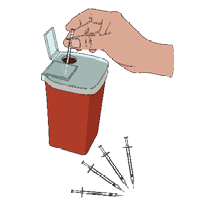
Needles should be disposed of in a “sharps container.” These plastic containers have thick walls and a secured lid that prevent accidental punctures. Ambulances will carry sharps containers and any needles found or used during an emergency can be placed in these containers. Always handle needles by the barrel (the plastic part with the plunger) and never try to re-cap a used needle.
Needles must never be discarded into the general garbage.
Gloves
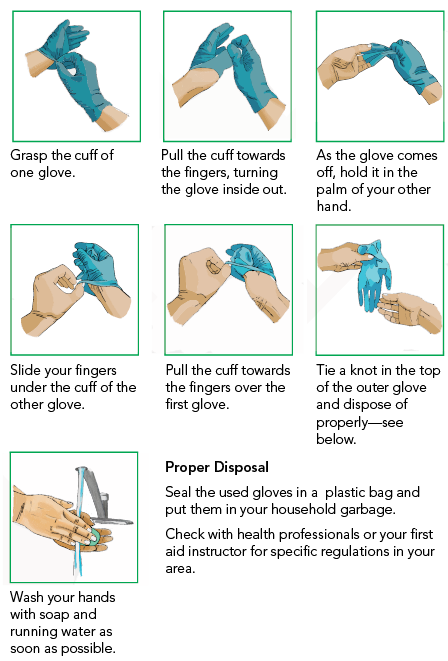
Once gloves have been used, they are contaminated and are a possible source of infection. Take them off without touching their outer surface following these illustrated steps.
 |
 |